
Multichannel Selling Challenges: 5 Common Problems and How to Overcome Them

The dream of multichannel selling is seductive: your products are everywhere your customers are. You’re catching the casual scroller on TikTok Shop, the intentional searcher on Google Shopping, the brand loyalist on your Shopify store, and the convenience-seeker on Amazon.
In theory, more channels equal more revenue. In practice, however, many merchants find that instead of multiplying their profits, they’ve simply multiplied their headaches.
As someone who has spent years navigating the backend of e-commerce operations, I’ve seen the "Growth Trap" firsthand. It’s that moment when a business scales from one channel to four, and suddenly, the manual processes that worked yesterday become the wildfires of today. If you feel like you’re playing a never-ending game of Whac-A-Mole with your orders and listings, you aren’t alone.
In this guide, we’re going to dissect the five most brutal multichannel selling challenges and, more importantly, provide the tactical blueprints to overcome them.
1. Managing Accounts Across Multiple Channels
Let’s start with the most immediate friction point: the sheer administrative weight of "being everywhere."
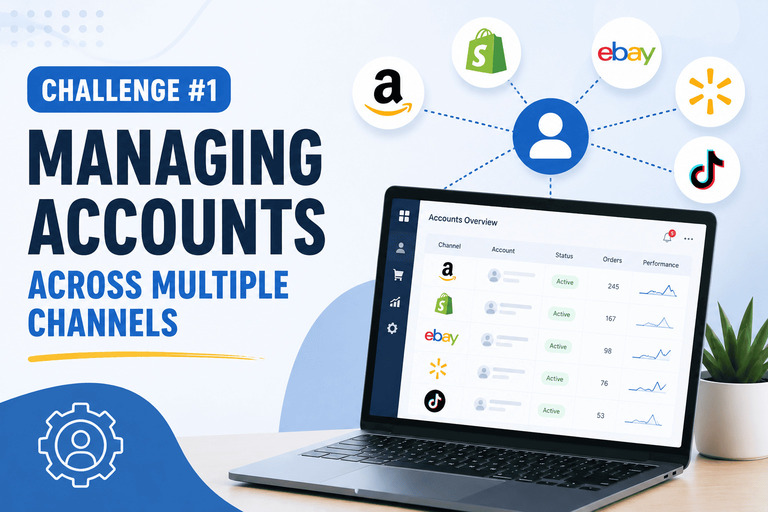
When you sell on Amazon, eBay, Walmart, and your own D2C site, you aren't just selling products; you are managing four distinct ecosystems. Each platform has its own UI, its own set of rules, its own notification system, and its own "Health Score."
The Problem: The Tab-Switching Fatigue
I call this the "Browser Tab Nightmare." Your team spends half their day logging in and out of different portals. Amazon’s Seller Central has a policy update you missed; eBay has a customer message buried in an inbox; Walmart just flagged a listing for a minor category error. This fragmented workflow leads to "context switching," which studies show can kill productivity by up to 40%. Even worse, things fall through the cracks. A missed notification on Amazon can lead to an account suspension, which is a death blow to cash flow.
The Solution: Centralized Command and Control
To survive this, you must move away from "platform-native" management.
- Unified Dashboards: Invest in a multichannel management tool (like Linnworks, Skubana, or Sellbrite) that pulls all notifications and account statuses into one screen.
- SOPs (Standard Operating Procedures): Create a daily checklist for account health. One person should be responsible for checking the "vitals" of all channels at 9:00 AM sharp.
- Permission Management: As you grow, use "User Permissions" wisely. Don't give everyone access to everything. Segment your team so one person owns the "Marketplace Health" while another handles "D2C Operations."
2. Cross-Channel Messaging and Branding
In the early days of e-commerce, you could get away with having different "vibes" on different sites. Not anymore. Today’s customer is a researcher. They might find you on Instagram, read reviews on Amazon, and eventually buy from your website.
The Problem: The Identity Crisis
If your brand voice is edgy and playful on TikTok but sounds like a dry legal document on Amazon, you create "cognitive dissonance." This kills trust. Furthermore, managing product descriptions across five channels is a nightmare. I’ve seen brands running a "Summer Sale" on their website while their eBay store is still showing "Winter Clearance" banners. It looks unprofessional and leads to "Where is my discount?" support tickets.
The Solution: The "Single Source of Truth" Strategy
- Digital Asset Management (DAM): Stop saving product photos in random desktop folders. Use a centralized DAM or a simple cloud-based PIM (Product Information Management) system where the "master" copy of every description, photo, and video lives.
- Brand Style Guides: Create a 5-page PDF that defines your tone, font, and color palette. Share this with every VA or agency you hire.
- Automated Syncing: Use tools that allow you to push a single update to all channels simultaneously. If you change a feature bullet point, it should update everywhere.
3. Managing Inventory Across Sales Platforms
If there is a "Boss Level" challenge in multichannel selling, this is it. Inventory management is the heartbeat of your business, and when it’s out of sync, the heart stops.
The Problem: The Ghost Inventory Scourge
Imagine you have 5 units of a high-demand coffee maker left. You have them listed on Shopify and Amazon. Suddenly, an influencer mentions your product. You sell 5 units on Shopify in three minutes. But Amazon doesn’t know that. Ten minutes later, someone buys 2 units on Amazon. Now you are "oversold."
You have to cancel those Amazon orders, which tanks your seller rating. Or, even worse, you hold back "safety stock" just in case, meaning you have inventory sitting in a warehouse not making money because you were too afraid to list it.
The Solution: Real-Time Inventory Synchronization
Manual spreadsheets are the enemy of scale.
- Inventory Buffers: Set a "buffer" in your management software. For example, if stock hits 2 units, tell the software to show "Out of Stock" on marketplaces while keeping those last 2 for your own website (where margins are higher).
- FBA as a Hub: If you use Amazon FBA, leverage "Multi-Channel Fulfillment" (MCF). This allows Amazon to ship orders from other channels, but you must ensure your software can talk to Amazon’s API in real-time to update stock levels.
- Barcoding: If you run your own warehouse, implement strict barcoding. Every "pick" must be scanned so the digital inventory matches the physical reality instantly.
4. Managing Pricing Across Channels
Pricing isn't a "set it and forget it" task. It’s a dynamic battle. However, in a multichannel world, your prices are constantly being compared—by customers and by the platforms themselves.
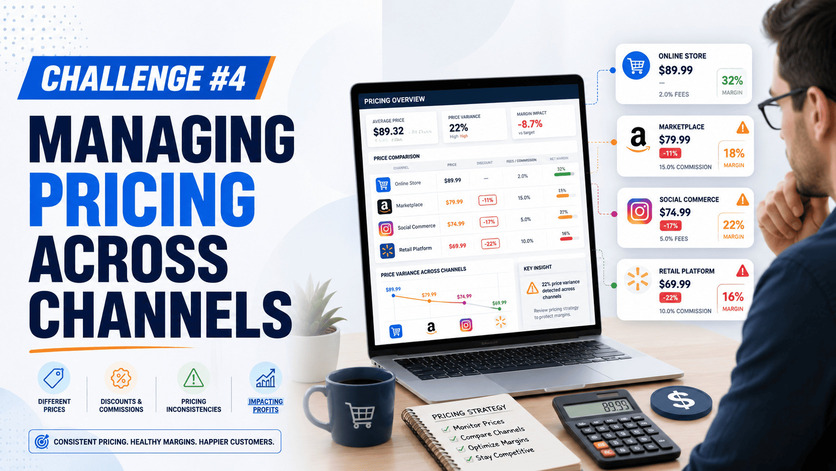
The Problem: The Race to the Bottom and Price Parity
Amazon is notorious for its "Fair Pricing Policy." If their bots find that you are selling the same item cheaper on your own website or Walmart, they will strip you of the Buy Box. On the flip side, each channel has different fees. You might pay 15% to Amazon, but only 3% in credit card fees on Shopify. If you have the same price on both, your net profit on Amazon is significantly lower.
The Solution: Value-Based and Dynamic Pricing
- Calculate "Channel-Specific" Margins: You need a spreadsheet that calculates your "Net-Net" profit per channel after shipping, commissions, and ad spend.
- Bundling Strategy: To avoid direct price comparisons and "Price Parity" issues, create unique bundles for different channels. Sell a single unit on Amazon, but a "3-Pack Value Bundle" on your website. This makes it impossible for bots to compare "apples to apples."
- Automated Repricers: Use a repricer (like Repricer.com or FeedVisor) for marketplaces to stay competitive, but set "floor prices" to ensure you never sell at a loss in the heat of a price war.
5. Reporting Across Multiple Sales Channels
You can't manage what you can't measure. But when your data is spread across four different CSV exports, getting a clear picture of your business health is like trying to solve a jigsaw puzzle in the dark.
The Problem: Data Silos
Amazon tells you your ACoS (Advertising Cost of Sales). Shopify tells you your Conversion Rate. Google Analytics tells you your Bounce Rate. But which channel is actually making you the most profit? Most sellers realize too late that their "best-selling" channel is actually their least profitable because of hidden returns, shipping surcharges, and high customer acquisition costs.
The Solution: Holistic Data Aggregation
- Contribution Margin Reporting: Stop looking at "Gross Revenue." Start looking at Contribution Margin per channel. This accounts for COGS, shipping, pick/pack fees, and marketing.
- Unified Analytics Tools: Use a tool like Glew.io, Triple Whale, or even a customized Looker Studio (formerly Google Data Studio) dashboard. You need one screen that shows you: Total Spend vs. Total Revenue across the entire brand.
- Standardized KPIs: Decide on 3-5 metrics that matter (e.g., LTV, CAC, MER - Marketing Efficiency Ratio) and track them the same way across every platform.
Conclusion
Multichannel selling is the only way to build a resilient, future-proof e-commerce brand. Relying on a single platform is like building a house on a rented lot—the landlord (Amazon or Google) can change the rules or kick you out at any time.
However, as we’ve explored, the "Multichannel Selling Challenges" are real and can be paralyzing. The secret to overcoming them isn't working harder; it’s building a system.
You need a tech stack that acts as a nervous system, connecting your brain (your strategy) to your limbs (your sales channels). You need to move from manual entry to automated flows, from fragmented branding to a unified voice, and from "guessing" your profits to data-driven decision-making.
The transition from a "seller" to an "omnichannel brand" is painful, but on the other side of that struggle is a business that scales while you sleep, rather than one that keeps you up at night.
Identify which of these five challenges is hurting you most today, and commit to fixing just that one this month. Your future self—and your bottom line—will thank you.